BRAZIL
WORLD FLAGS
SITE ON THE ORIGIN, DESIGN AND SYMBOLOGY OF THE FLAGS OF THE WORLD
#G / GHANA / Africa
GHANA

.GH
Official name:
Republic of Ghana
*English / Republic of Ghana
Capital: Accra
Idiom: English
Form of Government: Presidential republic
Currency: Cedi
Demonym: Ghanaian/-esa
Administrative divition: 10 Regions
FLAG
The national flag of Ghana consists of a horizontal triband of red, gold, and green. It was designed to replace the Blue Ensign of the Gold Coast colony. The flag was designed in 1957 by the late Theodosia Okoh and was adopted the same year that Ghana gained independence. The flag was flown until 1959 and then reinstated in 1966. It consists of the pan-African colors red, gold, and green, in horizontal stripes, with a black five-pointed star in the center of the gold stripe.
It was the second African flag after the flag of the Ethiopian Empire to feature these colors, although the colors are reversed.
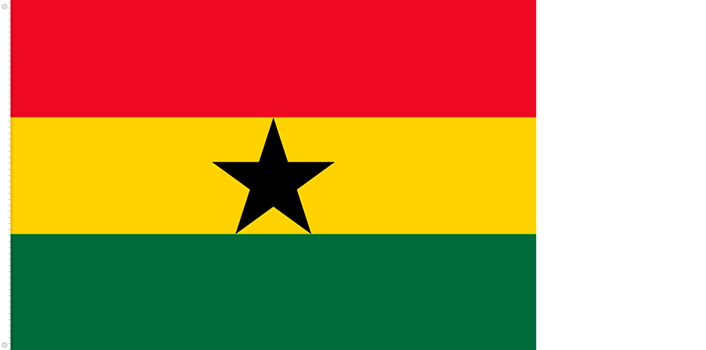
National flag
Ratio: 2 x 3


The red color of the national flag of Ghana was used to represent the blood of the ancestors who led the fight for independence and shared their blood through death. The country's fight for independence from the United Kingdom killed prominent Ghanaian leaders of the time. The names of the big six were Edward Akufo Addo, Dr. Ako Adjei, William Ofori Atta, Joseph Boakye Danquah, Emmanuel Obetsebi Lamptey, and later Osagyefor Dr. Kwame Nkrumah. The Big Six formed the United Gold Coast Convention (UGCC), an anti-colonial political party formed to gain Ghana's independence from British colonial rule. Red also represents the love that might have influenced our ancestors who led the struggles for the independence of Ghana out of love for the nation.
The color gold occupies the center line of the three-color attraction and represents the mineral resources found primarily in the Ashanti region of Ghana, helping to harness the wealth of the country. Gold is one of the mineral resources of Ghana found mainly in Obuasi and Tarkwa in the Ashanti region. The enrichment of Ghana's gold resources led to the initial name Gold Coast, later changed to Ghana following the struggle and success of gaining independence in 1957. Ghana's other mineral resources are diamond, bauxite and the manganese.
Green symbolizes the rich forests and natural wealth of Ghana that provide the nation with oil, food, and cash crops such as cocoa, timber, shea butter, and all kinds of food products for the country. The color green to this day is used as a symbol of the green vegetation of crops in Ghana. Ghana is noted for its cash crop of cocoa, which was first brought to Ghana by Tetteh Quarshie of Fernando Po. Most of Ghana's cash crops are exported to overseas countries in exchange for physical cash that is used for the development of roads, schools, water, sanitation, and industries for employment in the country.
The black star of the national flag of Ghana is a symbol used to represent the emancipation of Africa and unity against colonialism. The black star was adopted from the flag of the Black Star Line, a shipping line incorporated by Marcus Garvey that operated from 1919 to 1922. It is from where the Ghana national football team derives its nickname, the "Black Stars".
OTHER FLAGS

civil pavilion
Ratio: 2 x 3


Naval Pavilion
Ratio: 2 x 3

ICONOGRAPHY

Star
MEANING
It represents the emancipation of Africa and the unity against colonialism.
CONSTRUCTION

A : 9 | B : 4
COLORS
33 %
Red
HEX CODE
# ce1126
SYMBOLIZES:
THE BLOOD SPILLED BY THE ANCESTORS IN THE STRUGGLES FOR INDEPENDENCE
30 %
Yellow
HEX CODE
# fcd116
SYMBOLIZES:
REPRESENTS THE COUNTRY'S MINERAL RESOURCES
33 %
Green
HEX CODE
# 006b3f
SYMBOLIZES:
REPRESENTS THE RICH FORESTS AND NATURAL WEALTH
4 %
Black
HEX CODE
# 000000
HISTORY

africa flag
Western British

1870 - 1877

flag of the
Gold Coast
1877 - 1957

Flag of
Ghana
1957 - 1958

union flag
of African States
1958 - 1961

union flag
of African States
1961 - 1962

Flag of
Ghana
1962 - 1964

Flag of
Ghana
1964 - 1966

Flag of
Ghana
1964 - 1966
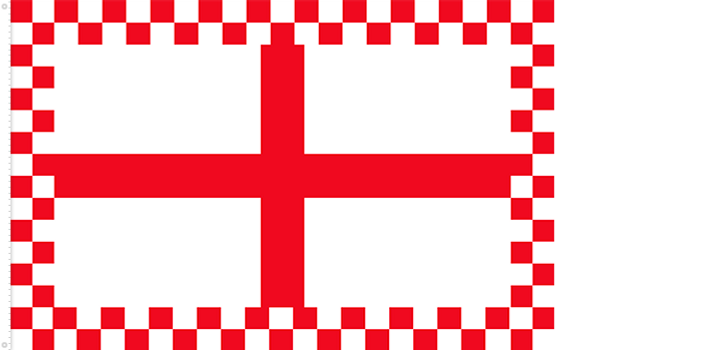
Flag of
Ghana
1964 - 1966

Flag of
Ghana
1964 - 1966
Flag of
Ghana
1964 - 1966

Flag of
Ghana
1964 - 1966

africa flag
Western British
1870 - 1877

flag of the
Gold Coast
1877 - 1957
Flag of
Ghana
1957 - 1958

union flag
of African States
1958 - 1961
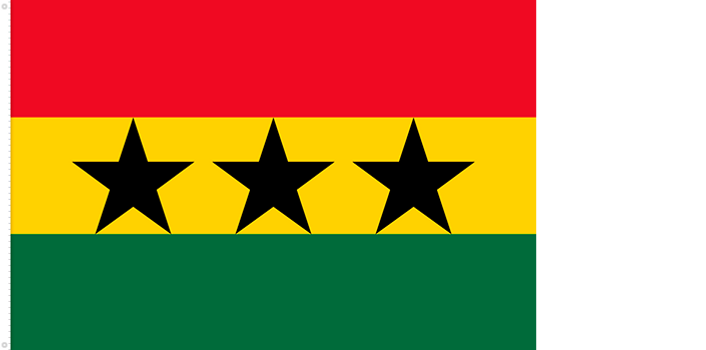
union flag
of African States
1961 - 1962
Flag of
Ghana
1962 - 1964

Flag of
Ghana
1964 - 1966
SHIELD
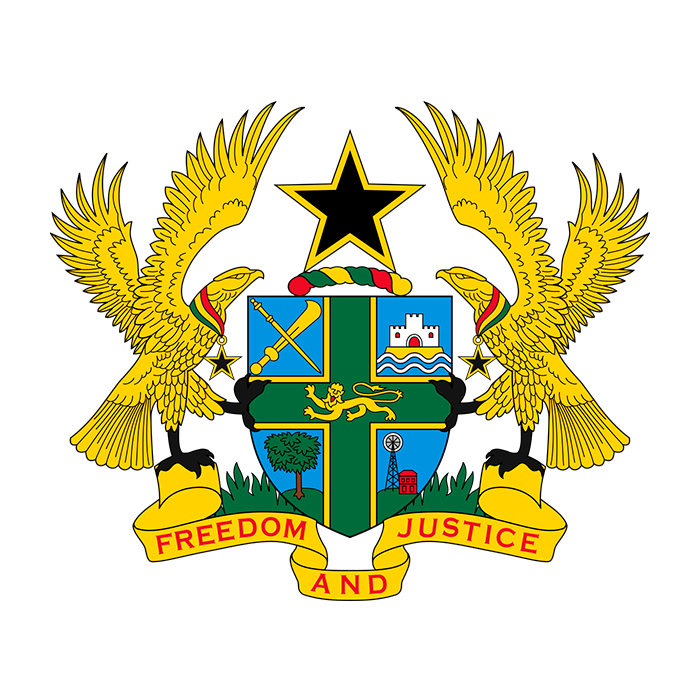
The coat of arms of Ghana was granted by Queen Elizabeth II on March 4, 1957. The coat of arms is divided into quadrants of azure by the Cross of Saint George, synople (green) with gold borders. The first quarter shows a crossed baton and sword; the second quarter a castle; the third quarter a cocoa tree and in the fourth a gold mine that symbolizes the mineral wealth of the country. In the center of the green cross is a golden lion, a symbol of the continuing link between Ghana and the British Commonwealth.
On the shield there is a burelete of gules (red), gold and synople surmounted by the black African star. Two gold eagles support the shield. On the edges appears the motto "Freedom and Justice" ("Freedom and Justice").