
BRAZIL
WORLD FLAGS
SITE ON THE ORIGIN, DESIGN AND SYMBOLOGY OF THE FLAGS OF THE WORLD
#AND / EL SALVADOR / Central America
THE SAVIOR
.SV
Official name:
Republic of El Salvador
Capital: San Salvador
Idiom: Spanish
Form of Government: Presidential republic
Currency: US Dollar, Bitcoin and Salvadoran Colon
Demonym: Salvadoran
Administrative divition: 14 Departments
FLAG
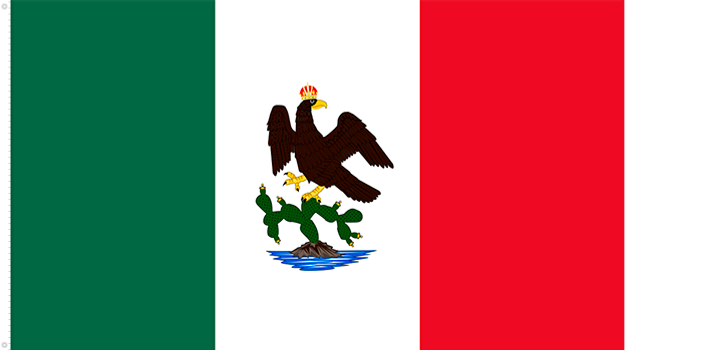
The flag of El Salvador is inspired by the flag of the Central American Federation of 1823, the colors were chosen by Manuel José Arce who appointed him as head of the Salvadoran militiamen who fought the annexation of the United Provinces of Central America to Mexico in 1822. In 1865, El Salvador experienced one of its first changes of flag in a transcendent way. Conservative President Francisco Dueñas decreed a profound change in the national flag, which began to be inspired by the American flag.
On May 17, 1912, the Legislative Power adopted it as a national symbol, taking it back as the first national flag but with cobalt blue. The initiative came from the President of the Republic, Dr. Manuel Enrique Araujo, who hoisted it for the first time on September 15 of that same year in the Presidential Tribune of the Campo de Marte and thus officially made it the new national symbol. The flag was also dedicated by a prayer created by David J. Guzmán in 1916 to dedicate the Salvadoran people to their homeland.

Magna flag
Ratio: 335 x 189


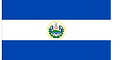
The Flag of El Salvador consists of three equal horizontal stripes, the two blue that are at the top and the bottom, and the white is located in the center of the flag. The current variation is distinguished into three types depending on its use, the Magna Flag is carried with the National Coat of Arms in the central strip, civil use has two versions: the first one left blank in the central strip, and the second is of design are carried from a Salvadoran motto in the central stripe.
According to the modern interpretation of colors and their meaning:
- Cobalt Blue: represents the sky that covers the Salvadoran homeland, and the two oceans that bathe in the Central American isthmus, the Atlantic and the Pacific.
- White: represents the peace that dominates the country and harmony, that is, the agreement and harmony that must exist between the people who inhabit this nation.
- Amber (For civil use): represents the writing of its motto of El Salvador.
OTHER FLAGS

First flag for civil use
Ratio: 3 x 5


Second Flag for civil use
Ratio: 3 x 5

CONSTRUCTION
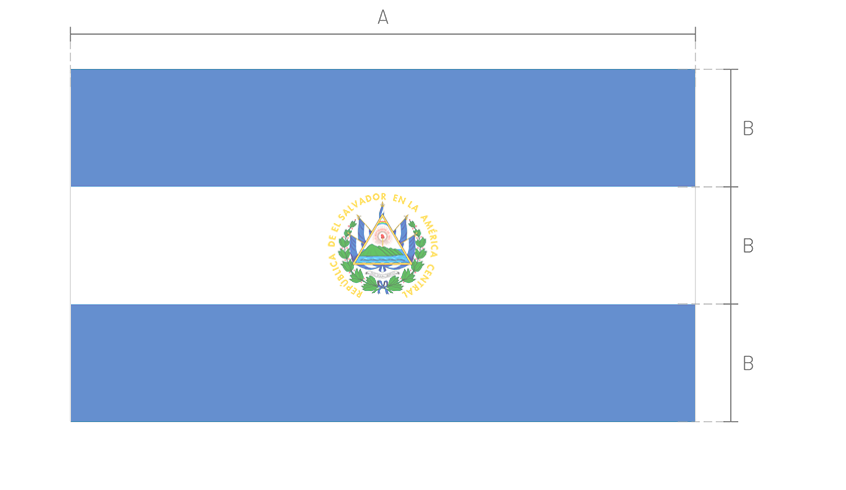
To : 670 | B : 126
COLORS
66 %
Red
HEX CODE
# 0047ab
SYMBOLIZES:
IT REPRESENTS THE SKY AND THE TWO OCEANS THAT BATH CENTRAL AMERICA (PACIFIC AND ATLANTIC)
33 %
White
HEX CODE
#ffffff
SYMBOLIZES:
PEACE AND CONCORD
HISTORY

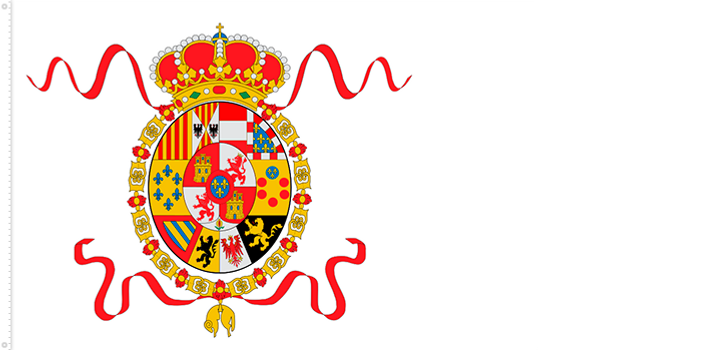
first flag of
The Savior

1822 - 1823
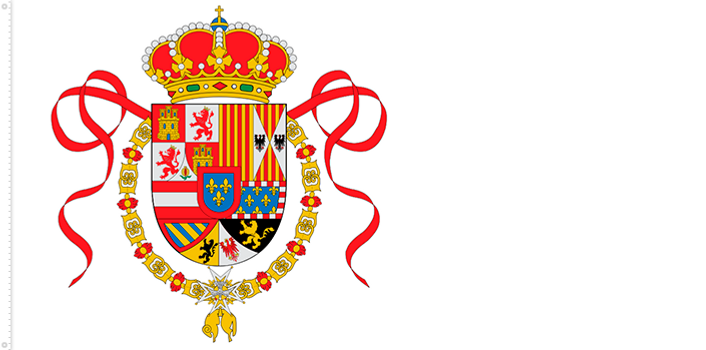
Flag of the Provinces
Nations of Central America
1823 - 1825
republic flag
Federal of Central America
1825 - 1841

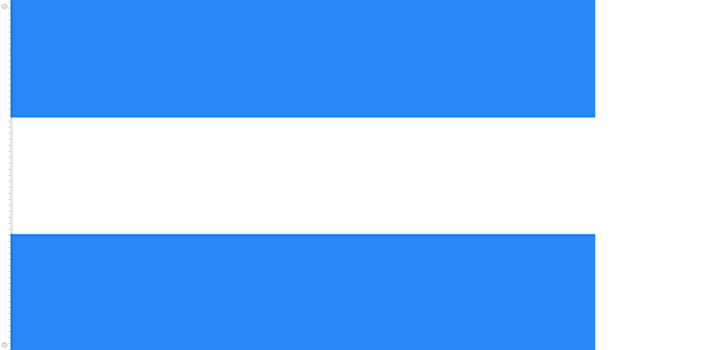
Flag of
The Savior
1865
first flag of
The Savior
1822 - 1823
Flag of the Provinces
Nations of Central America
1823 - 1825

Flag of the Provinces
Nations of Central America
1823 - 1825

republic flag
Federal of Central America
1825 - 1841
Flag of
The Savior
1865
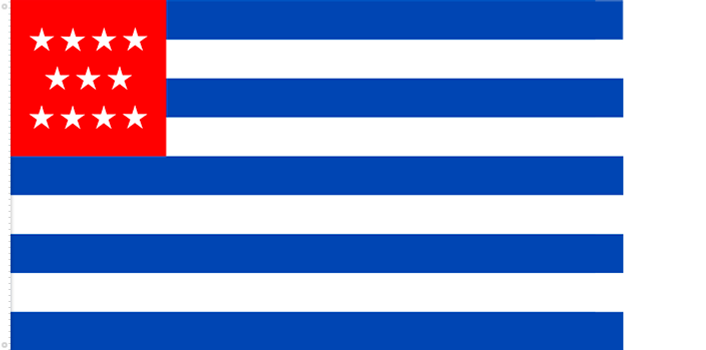
Flag of
The Savior
1865 - 1869

Flag of
The Savior
1869 - 1873

Flag of
The Savior
1873 - 1877
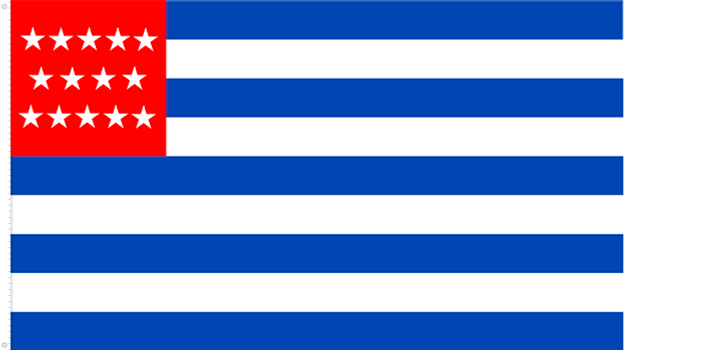
Flag of
The Savior
1877 - 1898
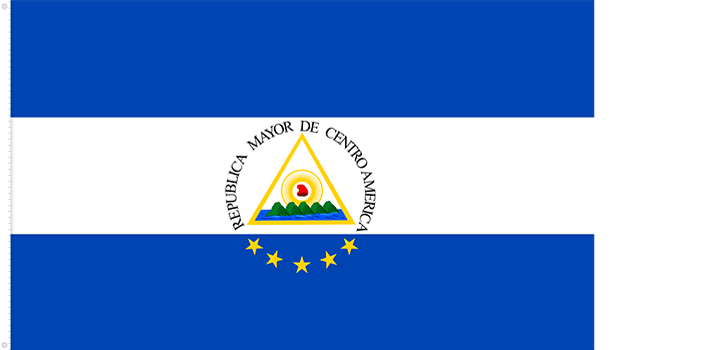
Flag of
The Savior
1898
Flag of
The Savior
1898 - 1912
SHIELD
The Coat of Arms of El Salvador was created together with the current National Flag by the Legislative Decree of May 17, 1912, with Dr. Manuel Enrique Araujo as President of the Republic. It was designed by the Salvadoran calligrapher Rafael Barraza Rodríguez, who won over thirty competitors in a contest promoted by the then Ministry of War and Navy, in 1912.
As a national symbol, it is approved and described by the Law of National Symbols that stipulates the elements that compose it and its position in the national coat of arms. Its components have the following meaning:
- Equilateral triangle: thick and golden amber, each of its angles represents the three Powers of the State (Legislative, Executive and Judicial).
- Mountain range of five magnificent forested conical volcanoes with a reddish sunrise sky on the horizon, located in a land surrounded by two seas: it represents the tropical and volcanic nature of the Salvadoran soil; the five volcanoes to the five nations of the isthmus, resulting from the Independence of Central America; and the seas, the Atlantic and Pacific oceans.
- A rainbow with a reddish sunrise sky: a symbol of peace.
- Liberty cap or Phrygian cap scattering golden amber lights: it proclaims freedom and its extensive spiral rays the ideals of the Salvadoran people.
- Legend "September 15, 1821": date of the Independence of Central America.
- Legend "República de El Salvador en la América Central": placed around the triangle in golden amber letters.
- Legend "God, Union, Liberty": placed at the base of the triangle, in black letters and a golden amber manuscript scroll.
- Five flags of El Salvador in indigenous spears, placed around the triangle: they represent the five nations resulting from the Independence of Central America.
- Two laurel branches intertwined with a blue and white ribbon: made up of fourteen segments that represent the fourteen departments into which El Salvador is administratively divided.
